Are you a graphic design student that’s about to graduate and start your career? Or maybe you’re someone that’s working in a different field, that’s looking to make it jump into graphic design. Or maybe you’re a designer that’s just looking to brush up on your fundamentals. If any of those sound like you, then you’re in the right place. Because today’s video is all about how to start your career as a successful graphic designer. Let’s get into it.
Welcome to Artful Ruckus. For those of you that are new here, my name is Tom Munz. I’m an art director and brand designer with over 15 years of experience. And this channel is all about helping creatives just like you take your craft, careers and confidence to the next level. I wanted to put together this video because I’ve seen a lot of questions from up and coming designers, junior designers, students, people just looking to break into the industry and they’re not really sure how to get started.
I keep seeing questions like, do I need to go to design school or can I be self-taught? What are some online courses I should be taking? What skills should I be focused on, and how do I start getting real world experience if I don’t have a portfolio or real client projects to showcase? Without further ado, let’s start jumping into these one by one.
So this first one is a hot topic. I’ve seen a lot of debate over the years. Do you need to go to design school to be a successful graphic designer, or can you be self-taught? And so my take is absolutely yes, you can be successful as a self-taught designer. You don’t have to go to design school. That being said, I do think that going to design school or being self-taught both have their own pros and cons. So I want to do a deeper dive on each of those two options so you can make a decision for yourself.
When it comes to going the design school route, I think some of the pros are that you’re just going to be living and breathing design for 2 to 4 years, all day, every day. So doing that, it just kind of becomes a part of you. It becomes second nature. It’s something that you’re just kind of engrossed in for a long period of time. And I think that sort of exposure and experience is invaluable.
Another advantage of going to design school is that it’s going to force you to learn the fundamentals. So if there’s certain areas that you’re not particularly interested in from a fundamental standpoint, if you’re a self-taught designer, maybe you’ll skip over them or not spend as much time learning them as you should. But going to design school is going to force you to sit there in that classroom, learn the material and learn the basics.
Another big advantage of going to design school is that you’re going to be surrounded by peers and teachers that are going to be in the design industry throughout your entire career, right? So you get to network with those people. You get to create relationships and friendships and add them to your LinkedIn and all that stuff. So that way and two, ten, 20 years, you’ll still be working with these people, right? They’ll be helping you get jobs. They’ll be inviting you to client projects for things that maybe they don’t have the skill set to do. So this group of people that you’re going to school with become your network of industry peers, which is really helpful. throughout your career.
One of the pros of going to a design school that I personally really benefited from is that it’s going to expose you to a lot of different types of design. So instead of just saying that, hey, I like doing logo design, that’s all I’m going to focus on. It’s going to make you try motion design and web design and typography and all these other aspects of design that maybe you would never have been exposed to otherwise. And so maybe you’ll end up finding a passion for something that you didn’t even realize that you’re interested in.
And lastly, design School is going to provide you with a set curriculum that’s made by people that have been there and done it. Right. So your professors are probably graphic designers currently working or retired. So they know what it takes to be successful in the industry, what clients want to see. And so your entire curriculum of what you’ll be learning is tailored to that.
Whereas if you’re learning on your own, there’s less of a set structure. You don’t really know what you don’t know.
When it comes to cons of going to design school, obviously the biggest, most obvious one is the cost. Tuitions are not cheap, especially if you go to one of these more well known design schools. So that’s something that you have to weigh personally to figure out what your budget is, what you can afford. How passionate are you about doing this as a career? I personally think it was worth the investment for myself, but again, I think it’s an individual decision that we all have to make.
Another potential con is that every design school is different, right? So the quality of your professors, of your curriculum, it’s going to be different depending on where you go. And so be sure to research where you’re going to make sure that, it’s well respected, that people that graduate speak highly of it. because that is a potential con that you could pay this money and go to design school and not really come up with an education that you feel satisfied with.
Lastly, another con is that going to design school for four years is a long time, right? So technically you could just be jumping into the industry and start working on client projects, getting experience, start making money earlier if you didn’t go to design school. So that’s another trade off you have to weigh when you’re making that decision.
When it comes to going the self-taught route, there’s plenty of pros as well. The first of which is that there’s plenty of free and cheap online resources out there that can teach you a lot of the same stuff that you’ll learn in design school.
When it comes to graphic design, there aren’t a lot of big secrets that you’re going to go to school and learn. A lot of this stuff is freely available information or things. You can get pretty cheap, and books and things like that. If you have the drive and you’re a self-starter, you can absolutely get 99% of the same information you would get from design school online.
Another pro of being a self-taught designer is that you can focus on the areas that you’re most passionate about. So let’s say that you absolutely know that you want to become an illustrator or a logo designer or something like that. You hate doing web design, or you hate doing these other parts of design that are adjacent to what you do. You can just pursue that, right? You’re creating your own curriculum, your own path, so you have a lot more freedom as a self-taught designer.
If you go to design school, you’re going to be forced to learn what everyone else is learning.
Another pro of being a self-taught designer is that you can just jump in and start doing it right. You can start working with clients, you can start making money. You can get a job. So that way you’re getting paid to do the learning on the job, which is always incredible when you have that, opportunity.
So I think that’s one of the big pros of being self-taught is just the freedom to get started earlier and to do things your own way.
One of the cons to being a self-taught designer, on the other hand, is that it can be challenging to have all that freedom. It can be challenging to have a lack of structure. Right. So you don’t have a curriculum. You have to be a self-starter to kind of keep yourself on task and make sure you’re diving deep enough on each of the fundamentals and skills that you need to learn.
Another challenge of being self-taught is that you don’t know what you don’t know when you’re starting out, right? So if you go to design school, you have professors that have been there, they’ve done that. They can show you the ropes and kind of tell you what pitfalls to avoid. Whereas if you’re self-taught, you’re just kind of figuring out on your own, and so it’s hard to know what the next steps are, what the best practices are.
So putting together a curriculum for yourself is a bit of a challenge. And while it’s great that there’s so many free or low cost online resources and courses out there, as a self-taught designer that you can take, one of the cons is that you have to sift through all of them, right. So there’s a lot of mediocre content out there, a lot of poor courses that are going to teach you bad habits. And as a self-taught designer, it’s up to you to sift through all of them, which can waste a lot of time.
And finally, as a self-taught designer, it can be challenging to get valuable critiques and feedback on your work.
So in design school, you get a critiques, you get feedback from your professor, you get graded on assignments. You talk to your peers about your projects. It’s kind of easy to get that feedback and see what you can improve, what you need to focus on. But as a self-taught designer, a lot of times you don’t have that. You can show it to your friends and family who are going to be supportive more than anything else. You can put it onto online forums, on graphic design subreddits, things like that. But you don’t really know who those people are that are giving you feedback, so you’re not sure what the value of that actually is. So that’s definitely another con there.
So that’s a look at the pros and cons of both of those two routes. Again I think both of them are totally viable. I personally did go to design school. I do think it was valuable for me, but I recognize that’s not the right path for everyone.
Luckily, when it comes to our field as designers, it’s all about the work, right? So if you have a great portfolio, your work looks professional. You’re going to be getting clients. They don’t care if you went to college or not. They don’t care what design school you went to. It’s about how good your portfolio is and how well you can do the job.
Whether you end up going to design school or you go the self-taught route, I think you need to come away with the same fundamentals, right? The same skills, the same understanding of design. And so that’s why I want to spend the rest of this video focused on is kind of getting that base level playbook put together. So that way you can be successful in your career as a designer.
So the first thing that I think every designer needs to be successful in this career is an understanding and a mastery of the fundamentals. Right. So learning things like color theory, typography, hierarchy, layout, composition, these are all just the basics that you’re going to need to be using on a day to day basis, no matter what sort of design that you’re doing.
So the first way I would recommend to start understanding these fundamentals, to learn what they’re all about is to study the greats.
Designers like Paula Scher, Paul Rand, Saul Bass, Massimo Vignelli, Milton Glaser, Dieter Rams these are all people that you should be very familiar with. You should know their work. You should understand what makes their work great. So really take the time to dissect it, recreate it, read their books, watch their biographies. Paula even has an online course that you can take. I highly recommend taking the time to do a deep dive on these greats, understand what makes them great, and learn the fundamentals by watching
Another great way to learn the fundamentals of design is by reading books. So there’s a ton of great ones out there. Some of the highlights I would recommend are:
This certainly is not an exhaustive list, and I’ve done a video that really goes into a deeper dive on a lot of these books, as well as some other recommendations, so recommend checking that out. But this is a great list to get you started and start understanding a lot of these fundamentals of design.
Another great way to start learning the fundamentals is with online courses, both free and paid.
So a few of my favorite courses I’ve taken are George Bokhua’s logo design classes on Skillshare, Jose Caballer’s UX design class on creative live, The Futur and the Futur Academy have some great resources, both free on YouTube and paid on their website. Daniel Scott’s series of Bring Your Own Laptop Courses is a great way to learn different design programs.
So we’ve talked about the fundamentals. We’re starting to check those off for our list. The next thing I want to talk about is growing your skill set as a designer.
So the first way to grow your skill set and this sounds obvious, but I know a lot of designers that don’t do this. But you have to keep putting in the reps. You have to keep practicing. You have to keep experimenting. You have to keep getting out of your comfort zone and pushing yourself. I find a lot of designers that kind of learn some tricks that they keep using, that they have a comfort zone of design, right?
They have a very distinct style. They have some templates built out, whatever the case may be, and they just keep using those same tricks over and over again, and they kind of stop growing. And so that’s going to stunt your career as a designer, right? You’re going to hit a certain level and you’re just going to kind of stagnate there. You’re going to stay at that level.
Making sure that you’re continuing to stay hungry, you’re continuing to practice. You’re opening up the programs, you’re experimenting, you’re pushing yourself is extremely important to continue to grow your skill set.
Another great way to grow your skill set as a designer is to replicate other designer’s work. So anytime you come across something that’s really inspiring to you, whether that’s a logo or a poster or an Instagram post, an ad, whatever it may be, take it and try to replicate it. Figure out why it’s so good – dissect it. Is it the typography? Is it the layout? The colors? What did they do that made that design so successful? Understand it, break it down and replicate it. Add all of that to your own repertoire.
Lastly, another great way to increase your skill set as a designer and make yourself more valuable is to stay up to date with industry news, trends and publications.
Seeing new work is going to inspire you. It’s going to push yourself to do better work. It’s going to give you ideas for future projects. It’s going to help you not stagnate.
As far as the publications and blogs that I recommend, keeping Up with Brand New is a great one for branding and logo design. Awwwards is great for web design inspiration. The Dieline and brands of the world are great sources for packaging design. And of course, Dribbble and Behance are great places just to keep up with the industry as a whole.
So now we’ve talked about education. We’ve talked about the fundamentals. We’ve talked about growing your skill set. The final piece of the puzzle is to build out your portfolio and to start getting clients.
The first question I see a lot is how do I build out a portfolio if I don’t have any clients? And so it’s a chicken or the egg type scenario, but I would recommend to working with non-profits, doing projects with them. Those are absolutely relevant, real projects you can put in your portfolio and also passion projects. I see that a lot where people don’t think that passion projects are relevant to a portfolio, but they absolutely are.
I think you can show off great design work, doing passion projects, and as long as you treat it like it’s a real client and you’re creating a case study that speaks to that, then I absolutely think it’s fine to include passion projects in your portfolio.
I think with both of those different routes, whether you’re volunteering for a charity or you’re doing a passion project, it’s important to keep in mind the clients that you’re trying to attract to your portfolio, right? You want to make sure that no matter what type of work you’re doing, it’s all relevant to your goal client.
So if you’re looking to work with breweries and restaurants, for example, you want to make sure that your passion projects reflect that, that you’re doing logo designs for breweries, that you’ve made up or whatever the case may be. Branding projects for brewery can designs and those sorts of things are going to speak to your goal client, because if you’re just creating a random passion projects and a random volunteer projects and putting all that interpret folio, it’s just going to look like a mishmash, and it’s not going to speak to the client that you’re hoping to attract.
And so you might be saying, well, I’m working for a nonprofit. I want to work for breweries. There’s not really like a nonprofit brewery. That’s okay. Just make sure that the work that you’re doing is at least in the same style. Right. So if these breweries are doing a lot of illustration or if they’re very modern, whatever the case may be, just try to find clients, try to find nonprofit clients that are doing that same style of work. So at least there’s still a through line to your goal client to where it’s relevant to them.
When it comes to presenting your work in your portfolio, I’ve done a couple of videos on this where I do really deep dive, so I’d recommend checking out those portfolio review videos. But essentially, you want to be creating case studies that tell a story.
So you want to start with what was the problem? How did you solve it? Show your process from concept to completion. Show some really great work with some great mockups, and then show the solution, which includes metrics of how you solve the problem, how impactful it was from an ROI standpoint. obviously, if it’s a passion project, you can’t do that. That’s totally fine. But once you do start getting real clients, make sure that you’re including business metrics and ROI, tangible results, and all of your case studies.
This is really important because most people that are looking at your portfolio, whether that’s a business owner, potential client, hiring managers, they all speak a different language than us, right? Like they’re probably not designers. They’re not really diving into things like typography and color palettes and stuff like that. They think in terms of business, right? They’re thinking in terms of profit. Is this a good investment to hire this designer, or are they going to be a good fit on the team.
It’s important to take your entire portfolio, those case studies and cater it to your target audience.
So now that you’ve done some work with nonprofits and you’ve create some passion projects, maybe have a real client or two in your portfolio. Now it’s time to send that out to your family and friends. Let them know that you’re looking for work.
The best way to get new clients is from word of mouth. And so your personal network of people that you already know, they’re going to give you a glowing recommendation to their friends, people that own businesses, that’s going to be the best way for you to get your foot in the door and start getting your first clients.
It’s also a good idea to start posting your work on social accounts again, thinking about where your ideal client or, hiring manager is going to be. So if that’s LinkedIn or Instagram, whatever the case may be, post your work there on a regular basis so you have a higher chance of being found, of being discovered and getting hired.
And finally, another way to get clients is to go physically where they are, right? So in that past example, I talked about wanting to do design for breweries. So if that’s the case, go bring your laptop to the brewery and work there right on a regular basis. You’ll get to know the bartenders or get to know the owners. nd then you can just casually drop your card because you know them now, and they’re going to hire people that they know and that they like more so than they’re going to go out and hire random designer off of Google.
Note that some of the links included in this article are affiliate links that support the site at no cost to you. Thanks for your support!
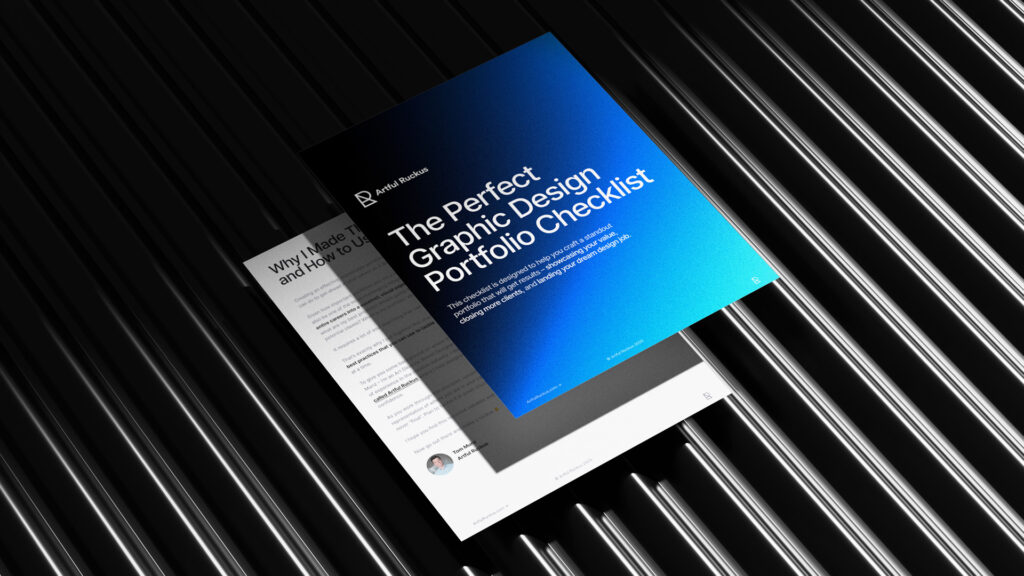
This free download will help you attract more clients and land that design job you’ve been dreaming about.
📈 Showcase your value to clients and recruiters
✍️ Write engaging case studies
🔥 Stand out in a crowded market
This free download will help you attract more clients and land that design job you’ve been dreaming about.
📈 Showcase your value to clients and recruiters
✍️ Write engaging case studies
🔥 Stand out in a crowded market